
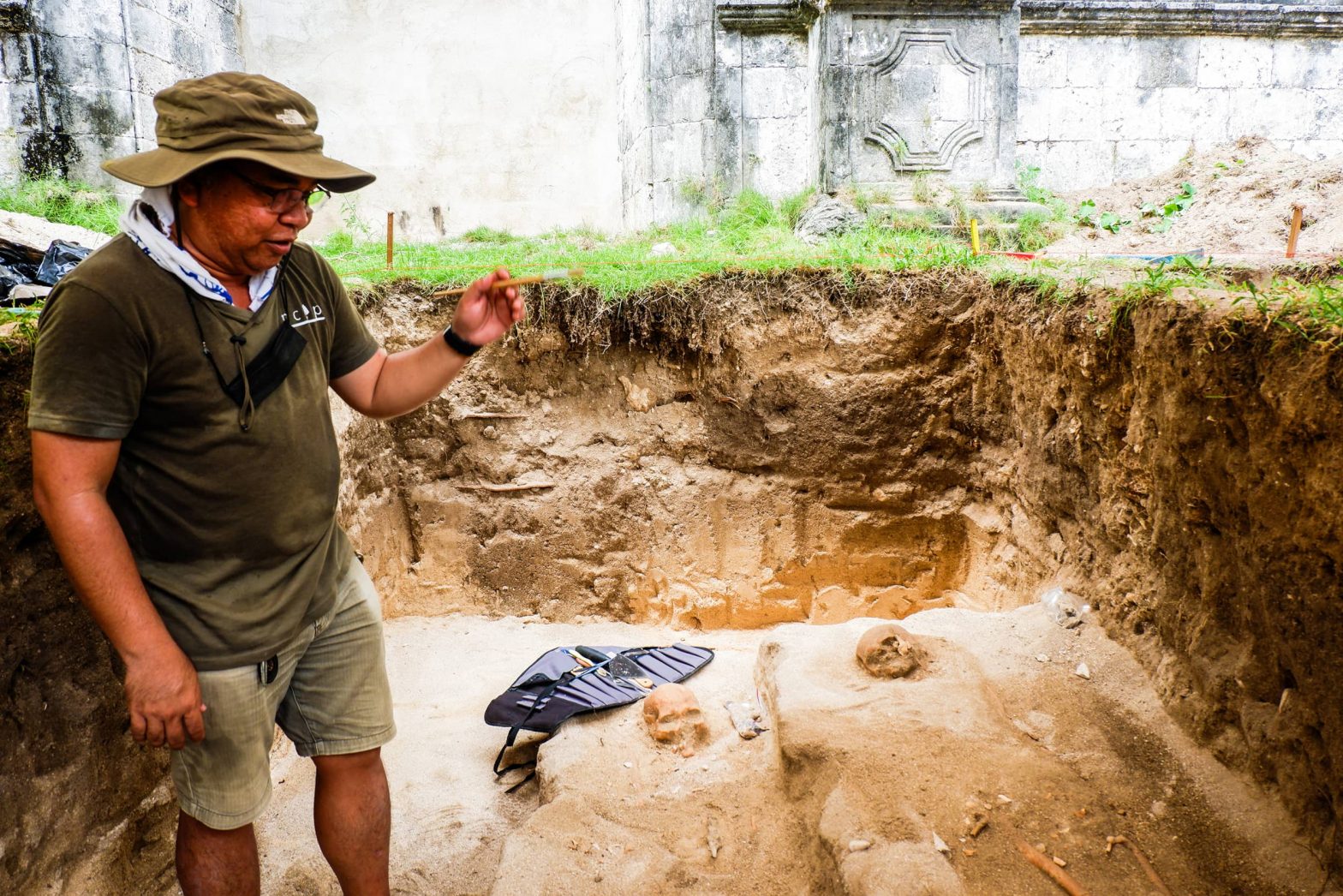
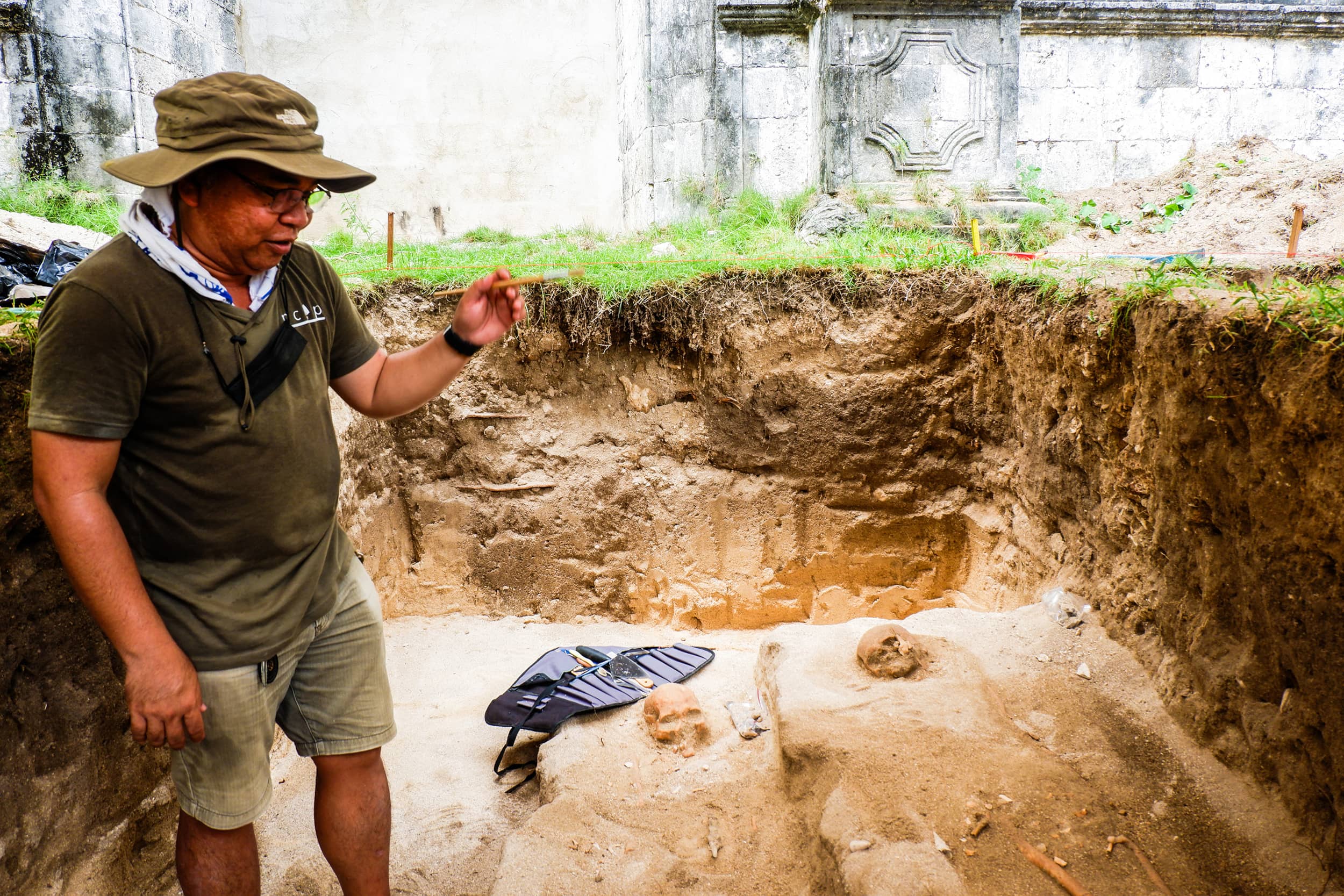
Two burial sites about 50 meters from each other but centuries apart offer a peek into the life and death of pre-colonial Cebuanos. One site had jars buried with the remains, the other had remains buried in a jar.
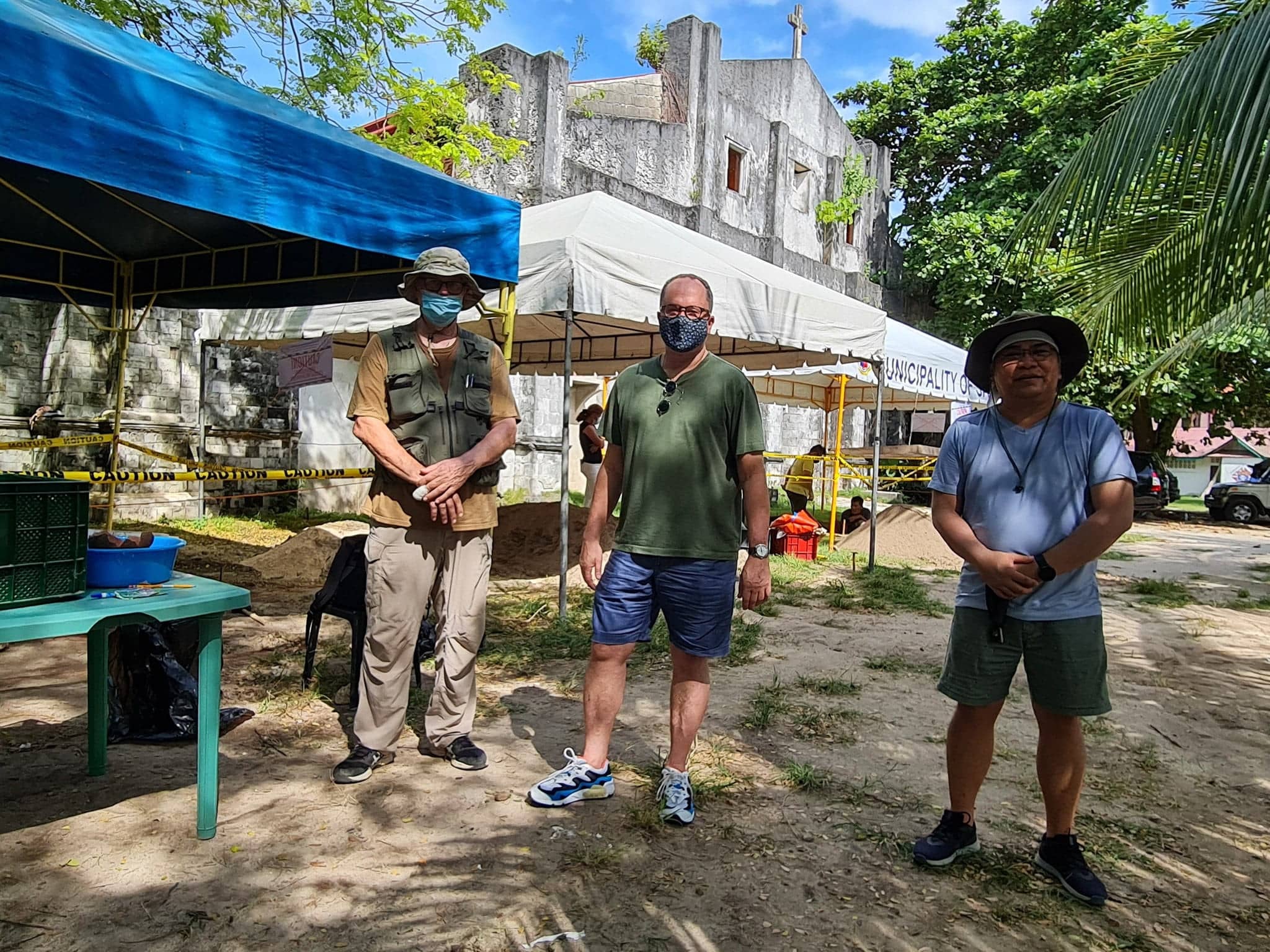
A return dig by the National Museum of the Philippines and the University of San Carlos at the back of the San Juan Nepomuceno Parish Church in San Remigio in northern Cebu uncovered more human remains and artifacts such as earthenware.
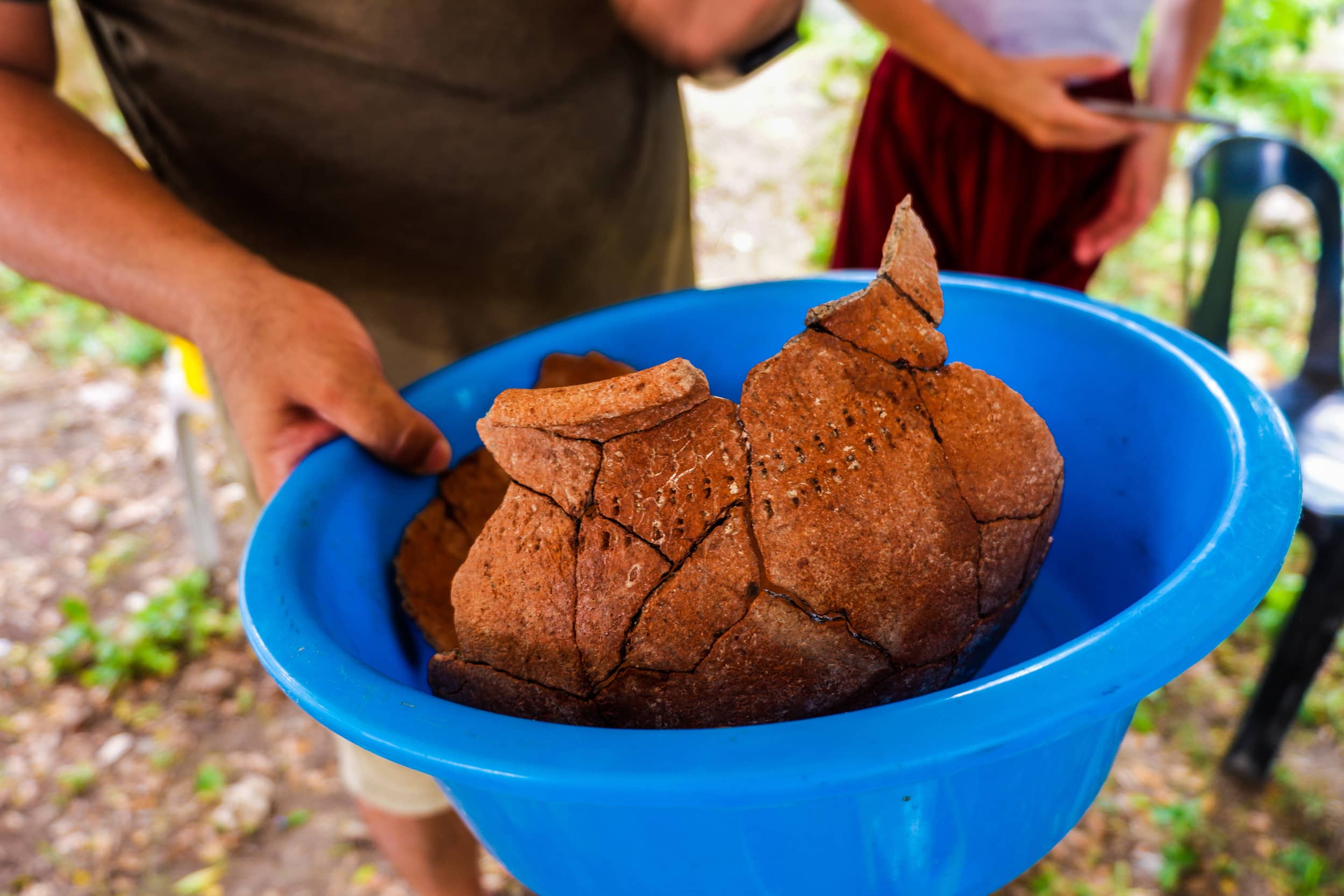
“Observe the carination,” Dr. Jose Eleazar Bersales said as he held out one pot, painstakingly reconstructed by graduate student Venice Moore from fragments they dug up at the churchyard. A carinated pot shows a sharp angle on its profile, he said, “running down from the neck to the middle part of the body. This design is commonly seen among pots dating to the Philippine Iron Age, between 500 BCE and 900 CE.”
He pointed out the delicateness of the earthenware and its craftsmanship when Rappler visited the dig site on July 30. One pot they dug up contained etched patterns made by pressing the outer edges of bivalves on the earthenware. Another jar, he said, was likely meant for water because of its narrow opening and was most probably hung at home because of the absence of a flat base.
But Bersales said appreciation for the locally-made pot waned when we started trading with the Chinese centuries later. We came to love ceramics and preferred the imports, he said.
The Northern Cebu Archaeological Project (NCAP) is supported by the Cebu Provincial Government and the Municipality of San Remigio. It is funded by Aboitiz Foundation, Inc. NCAP is headed by Dr. John Allen Peterson and Bersales. The current excavation is a return dig. They first excavated the sites in 2011 and 2012.
In the previous dig, Bersales said they recovered burials and earthenware of similar design to what they again excavated now. They also found a number of burial jars at the Lapyahan public beach at the back of the church. He said the ones at the church are all primary burials and not secondary, a practice when the body is buried first and then after some time, the bones are cleaned and placed in jars.
What they have uncovered indicates that the two sites are of different time periods, Bersales said.
The difference with the current dig is that the team will include DNA analysis and more radiocarbon dating from the burials as well as the soil.
“Since we started in 2012, we actually have no radiocarbon date for jar burials,” Bersales said.
In the burials just behind the church, Bersales pointed out the alignment of the remains, with feet pointing to the shore. He said pre-colonial people may have thought that the afterlife was just beyond the horizon and aligned the body toward it. But a nearby skeleton may challenge that assumption, he said. It was buried with feet away from the shore.
Two skeletons found in the churchyard likely date back to the Iron Age. Carbon dating will determine this for sure, said Bersales, but the time period is indicated by the presence of pottery similar to the Kalanay Pottery Complex first reported by Wilhelm Solheim II in Kalanay Cave, Masbate in the 1950s, dating to the Philippine Iron Age.
He said the pots likely contained water and food for the afterlife. The dead were buried near their homes. “The cemetery is a Western invention,” Bersales explained.
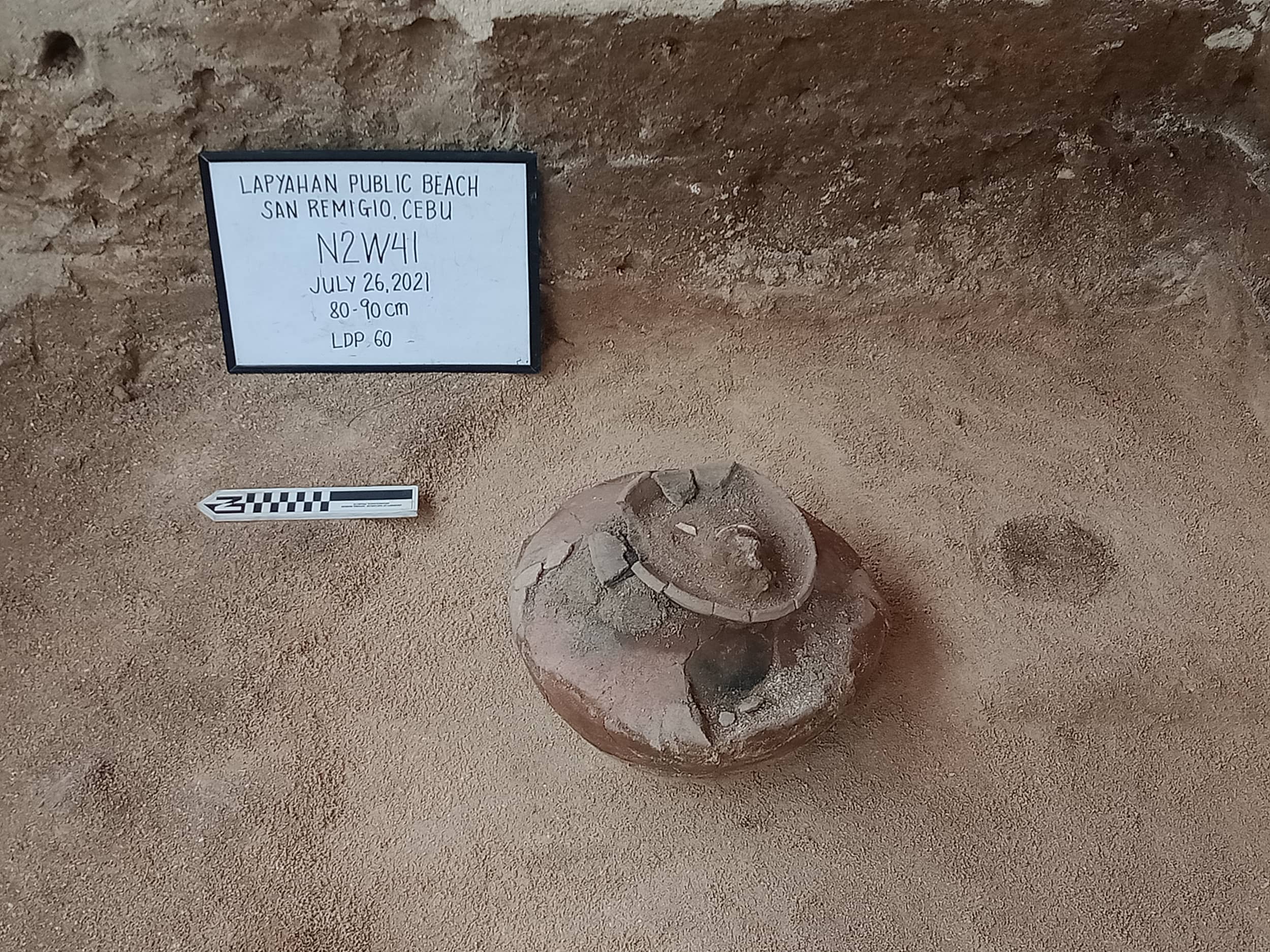
Across the road and right at the Lapyahan public beach, the team found a burial jar and another set of remains. Bersales said these likely dated back 1,000 years.
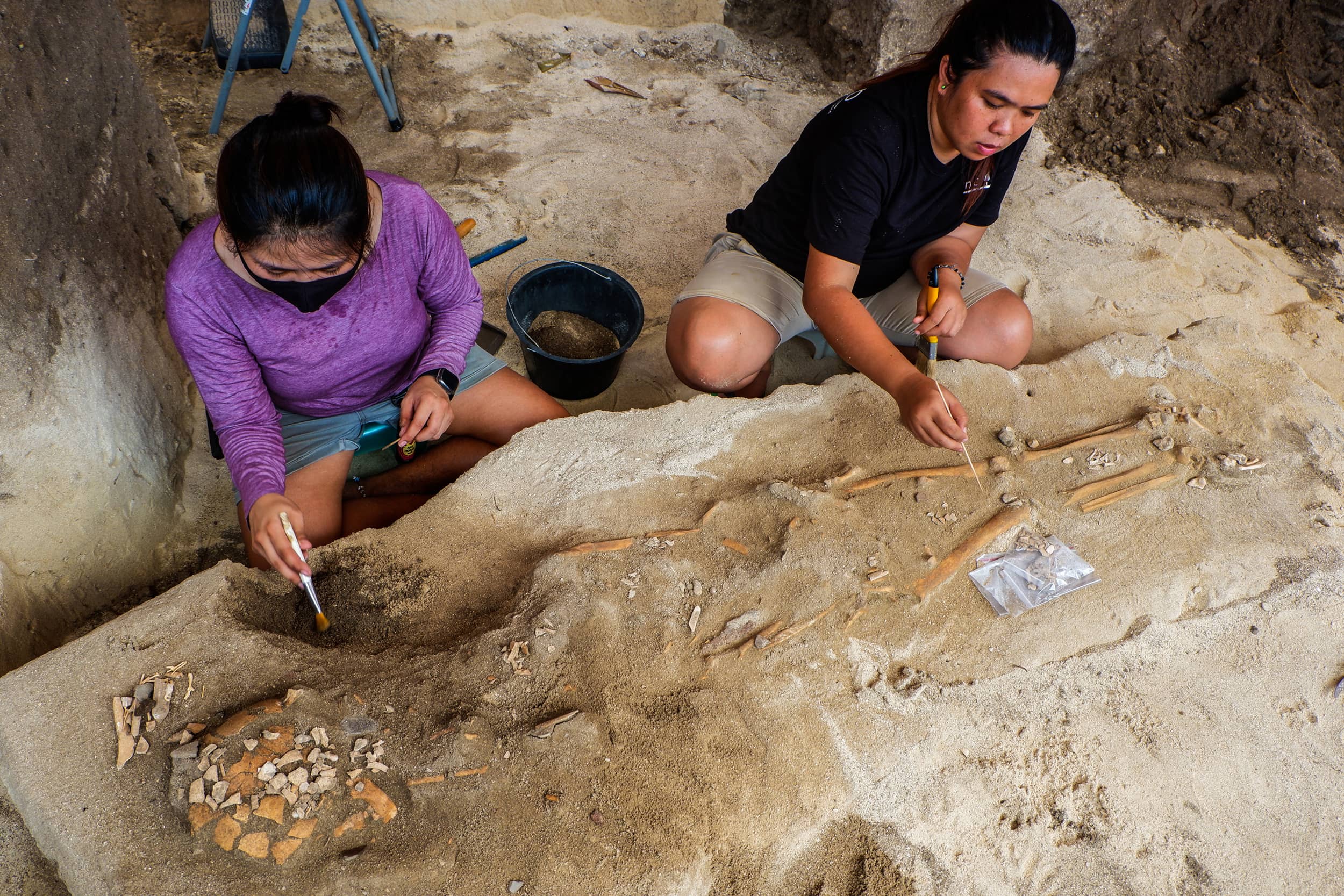
When Rappler visited, graduate students Maria Cecilia Cabañes and Candice Theara Cañete were using brushes to expose the skeleton. This was disturbed, Cabañes said, pointing to the skull that she said was unnaturally facing sideways. The skeleton had a dagger-like tool buried with it. The remains were buried under what used to be a public school. What remained of its concrete floor is still visible at the dig site.
Bersales said that when they removed parts of the contents of the burial jar for sampling, they found remnants of a human child and two shell bracelets.
The NCAP dig at San Remigio was scheduled to wrap up this week but has been extended by almost a week, courtesy of the Municipal Government. NCAP will hold a press conference to talk about the dig and share their findings.